But if a twin, called by the name of Castor & Pollux. Often, there is even more complex.
Meteors are parts of salt-peter and sulfur from the areas that are more heterogeneous.
Something of this kind tried in the fire meteor, is a lightning-bolt, which is, that the smoke of a nitrous lake, sulpherous, the clouds above A, great force into the lower B dropped, a falling, and the ends of the lands C and D, for the sake of the air presses, that place, out of the shortness of the ways of a more easily able to go forth, en-route the lower B running with them, was intercepted and concluded that the agitation intensity of the vapors are separated and then to a great crash out of the cavity E by the gap G or F breaks.
Sally
sin geminus, Castoris & Pollucis nomine appellatur. Saepe etiam est magis multiplex.
meteora partium nitrosarum & sulphur e arearum , magis est heterogeneus.
Ejusmodi ignitum meteorum eft fulmen: quod est fumus nitrosus, sulpherous, nubibus superioribus A, magno impetu in inferiores B delabentibus, & extremitatibus suis C & D, propter aerem preffum, ibi ob brevitatem viae facilius egredientem, vesus inferiores B concurrentibus, interceptus & conclusus, qui agitatione vehementia vaporibus separatus & incensus, magno fragore ex earum cavitate E per hiatum G vel F erumpit.
Eruptio
1 What are object pronouns?
- Object pronouns are words such as me, him, us and them used instead of a noun
to show who is affected by the action of the verb.
Do you like Claire? – Yes I like her a lot.
I’ve lost my purse, have you seen it?
He gave us a fantastic send-off.
Why don’t you send them a note?
- In English we use object pronouns in two different ways:
- when the person or thing is directly affected by the action:
I saw them yesterday.
They admire him immensely.
- In the above examples, them and him are called direct objects.
- when the person or thing is indirectly affected by the action. In English you often use to with the pronoun in such cases.
I sent it to them yesterday.
They awarded him a medal.
- In the above examples, them and him are called indirect objects.
- For both direct and indirect objects there is one form you use on most occasions. This is called the unstressed form.
2 Unstressed direct object pronouns
- Here are the Italian unstressed object pronouns:
| mi |
me |
| ti |
you (familiar singular) |
| lo |
him, it |
| la |
her, you (polite singular), it |
| ci |
us |
| vi |
you (plural) |
| li |
them (masculine) |
| le |
them (feminine) |
- Unlike English, you usually put them before the verb.
| Ti amo. |
I love you. |
| Lo invito alla festa. |
I’m inviting him to the party. |
| Non lo mangio. |
I’m not going to eat it. |
| La guardava. |
He was looking at her. |
| Vi cercavo. |
I was looking for you. |
| Li conosciamo. |
We know them. |
TipRemember that you use ti only when speaking to someone you know well.
3 Lo, la, li and le
- You need to pay particular attention to how lo, la, li and le are used in Italian.
- To translate it you need to choose between lo or la. Use lo if the noun referred
to is masculine, and la if it’s feminine.
| Ho un panino, lo vuoi? |
I’ve got a roll, do you want it? |
| Ho una mela, la vuoi? |
I’ve got an apple, do you want it? |
- To translate them you choose between li or le. Use li if the noun referred to is masculine, and le if it’s feminine.
| Sto cercando i biglietti. |
I’m looking for the tickets, have |
| Li hai visti? |
you seen them? |
Dove sono le caramelle?
Le hai mangiate? |
Where are the sweets? Have you
eaten them? |
- When lo and la are followed by ho, hai, ha, abbiamo, avete and hanno, they drop the vowel and are spelled l’.
| Non l’ho visto ieri. |
I didn’t see it yesterday. |
| L’abbiamo portato con noi. |
We took it with us. |
| L’hanno cercato tutta la giornata. |
They looked for it all day. |
Grammar Extra!When you are talking about the past and using the pronouns lo, la, li and le you must make the past participle agree with the noun being referred to. Past participles are just like adjectives ending in –o. You change the –o to –a for the feminine singular, to –i for the masculine plural, and to –e for the feminine plural.
| Il suo ultimo film? L’ho visto. His new film? I’ve seen it. |
| Silvia? L’ho incontrata ieri. Silvia? I met her yesterday. |
| I biglietti? Li ho già presi. The tickets? I’ve already got them. |
| Queste scarpe? Le ho comprate anni fa. These shoes? I bought them years ago. |
Key points
- You generally use the unstressed direct object pronoun.
- Unstressed direct object pronouns usually come before the verb.
- You need to pay special attention when translating it and them.
4 Unstressed indirect object pronouns
- In English some verbs have to be followed by an indirect object pronoun – explain
to him, write to him – but other similar verbs do not: you say tell him, phone him.
- In Italian you have to use indirect object pronouns with verbs such as dire (meaning to tell) and telefonare (meaning to phone).
- As with direct object pronouns, there are unstressed and stressed indirect
object pronouns.
- You will generally need to use unstressed pronouns rather than stressed ones.
- Here are the unstressed indirect pronouns.
| mi |
to me, me |
| ti |
to you, you (familiar singular) |
| gli |
to him, him |
| le |
to her, her; to you, you (polite singular) |
| ci |
to us, us |
| vi |
to you, you (plural) |
| gli, loro |
to them, them |
- Unlike English, you usually put these pronouns before the verb.
- Just as in English, when you are telling somebody something, giving somebody something and so on, you use an indirect pronoun for the person concerned.
| Le ho detto la verità. |
I told her the truth. |
| Gli ho dato la cartina. |
I gave him the map. |
- Indirect pronouns are also generally used with verbs to do with communicating with people.
| Gli chiederò il permesso. |
I’ll ask him for permission.
(literally, I’ll ask to him) |
| Gli ho telefonato. |
I phoned him. (literally, I phoned to him) |
| Le scriverò. |
I’ll write to her. |
| Se li vedi chiedigli di venire. |
If you see them ask them to come.
(literally, …ask to them…) |
- You use indirect object pronouns when you are using verbs such as piacere, importare, and interessare to talk about what people like, care about or are interested in.
| Gli piace l’Italia. |
He likes Italy. |
| Le piacciono i gatti. |
She likes cats. |
| Non gli importa il prezzo, sono ricchi. |
They don’t care about the price, they’re rich. |
| Se gli interessa può venire con me. |
If he’s interested he can come with me. |
TipIt is worth checking in your dictionary to see if a verb needs a direct or
an indirect object. If you look up the verb to give, for example, and find the example to give somebody something, the a in the translation (dare qualcosa a qualcuno) shows you that you use an indirect pronoun for the person you give something to.
| Gli ho dato il mio numero di telefono. |
I gave him my phone number |
Key points
- You generally use the unstressed indirect object pronoun.
- Unstressed indirect object pronouns are used with many verbs in Italian which do not use them in English such as chiedere (meaning to ask) and interessare (meaning to interest).
- Unstressed indirect object pronouns usually come before the verb.
5 Stressed object pronouns
- You use stressed pronouns for special emphasis. They generally go after the verb.
| Cercavo proprio voi. |
You’re just the people I was looking for. |
| Invitano me e mio fratello. |
They’re inviting me and my brother. |
- They are exactly the same as the subject pronouns, except that me is used instead of io and te is used instead of tu.
- You use the same words for stressed direct and indirect objects. When you use them as indirect objects you put the word a (meaning to) before them.
| DIRECT |
|
| me |
me |
| te |
you (familiar form) |
| lui |
him |
| lei/Lei |
her, you (polite singular) |
| noi |
us |
| voi |
you (plural) |
| loro |
them |
| INDIRECT |
|
| a me |
(to) me |
| a te |
(to) you (familiar form) |
| a lui |
(to) him |
| a lei |
(to) her, you (polite singular) |
| a noi |
(to) us |
| a voi |
(to) you (plural) |
| a loro |
(to) them |
- You use stressed pronouns:
- when you want to emphasize that you mean a particular person and not somebody else, and for contrast:
| Amo solo te. |
I love only you. |
| Invito lui alla festa, ma lei no. |
I’m inviting him to the party but
not her. |
| Non guardava me, guardava lei. |
He wasn’t looking at me, he was
looking at her. |
| Ho scritto a lei, a lui no. |
I wrote to her, but not to him. |
Questo piace a me, ma Luca
preferisce l’altro. |
I like this one but Luca prefers the other one. |
| Vengo con te. |
I’ll come with you. |
| Sono arrivati dopo di noi. |
They arrived after us. |
- after di when you’re comparing one person with another
| Sei più alto di me. |
You’re taller than me. |
| Sono più ricchi di lui. |
They’re richer than him. |
Key points
- Stressed object pronouns are nearly all the same as subject pronouns.
- You use them for emphasis, after prepositions and in comparisons.
- You generally put stressed object pronouns after the verb.
- You use the same words for direct and indirect objects, but add a before them for indirect objects.
6 Before or after the verb?
- Unstressed pronouns generally come before the verb.
| Mi aiuti? |
Could you help me? |
| Ti piace? |
Do you like it? |
| Ci hanno visto. |
They saw us. |
| Vi ha salutato? |
Did he say hello to you? |
- In some cases, unstressed pronouns come after the verb:
- when you are using the imperative to tell someone to do something. The pronoun is joined onto the verb.
| Aiutami! |
Help me! |
| Lasciala stare. |
Leave her alone. |
| Daglielo. |
Give it to him (or her). |
| Arrivano. Non dirgli niente! |
They’re coming. Don’t tell them
anything! |
- Note that if the verb consists of just one syllable you double the consonant the pronoun starts with, except in the case of gli.
| Fallo subito! |
Do it right away! |
| Dille la verità! |
Tell her the truth! |
| Dimmi dov’è. |
Tell me where it is. |
| Dacci una mano. |
Give us a hand. |
| Dagli una mano. |
Give him a hand. |
- when you are using a pronoun with the infinitive (the form of the verb ending in –re in Italian). The pronoun is joined onto the verb.
| Potresti venire a prendermi? |
Could you come and get me? |
| Non posso aiutarvi. |
I can’t help you. |
| Devo farlo? |
Do I have to do it? |
| Dovresti scriverle. |
You ought to write to her. |
| Luigi? Non voglio parlargli. |
Luigi? I don’t want to talk to him. |
- Note that the final e of the infinitive is dropped: prendere + mi becomes prendermi, fare + ti becomes farti and so on.
- Stressed pronouns often come after the verb.
| Amo solo te. |
I love only you. |
| Invito lui alla festa, ma lei no. |
I’m inviting him to the party but
not her. |
7 Using two pronouns together
- In English you sometimes use two pronouns together, one referring to the indirect object and the other to the direct object, for example, I gave him it.
- You often do the same kind of thing in Italian, and must always put the indirect object first.
- When you use two pronouns together like this, some of them change:
| mi becomes me |
| ti becomes te |
| ci becomes ce |
| vi becomes ve |
| Me li dai? |
Will you give me it? |
| È mia, non te la do. |
It’s mine, I’m not going to give it to
you. |
| Ce l’hanno promesso. |
They promised it to us. |
| Ve lo mando domani. |
I’ll send it to you tomorrow. |
- When you want to use gli (meaning to him or to them) and le (meaning to her) with lo, la, li or le, you add an –e to gli and join it to lo, la, and so forth.
| gli/le + lo → glielo |
| gli/le + la → gliela |
| gli/le + li → glieli |
| gli/le + le→ gliele |
| Glieli hai promessi. |
You promised them to her. |
| Gliele ha spedite. |
He sent them to them. |
| Carlo? Glielo dirò domani. |
Carlo? I’ll tell him tomorrow. |
- When you use two pronouns together to give an order or when using the infinitive (–re form of the verb), they join together and are added on to the verb.
| Mi piacciono, ma non vuole comprarmeli. |
I like them but he won’t buy me them. |
| Ecco la lettera di Rita, puoi dargliela? |
Here’s Rita’s letter, can you give it to her? |
| Le chiavi? Dagliele. |
The keys? Give them to her. |
| Non abbiamo i biglietti – può mandarceli? |
We haven’t got the tickets – can you send us them? |
- Note that the final e of the infinitive is dropped: prendere + mi + li becomes prendermeli, mandare + ti + le becomes mandartele and so on.
Key points
- When you use two pronouns together the indirect object comes first.
- Some indirect objects change when used before a direct object.
- After orders and the infinitive form, the two pronouns are written as one word and follow the verb.
Grammar Extra!In English you and one are used in general statements and questions such as You don’t do it like that; Can you park here?; One has to be careful.Use si and the reflexive form of the verb in Italian for these kinds of statements and questions.
| Si fa così. |
This is how you do it. |
| Si può nuotare qui? |
Can you swim here? |
| Non si sa mai. |
You never know. |
For first and second person, direct and indirect are the same, so you only have to learn one set. Me is mi, you is ti, us is ci, you-plural is vi.
For the third-person ones is that direct objects are just as you'd want them to be lo is him, la is her, li is them, le is them-female. Indirect objects are all gli except single women, who're le.
In Italian, some verbs are reflexive, meaning that the person doing the action does it to him or herself. Examples of this would be “mettersi” (to put a piece of clothing on), “chiamarsi” (literally “to call oneself”), and “sentirsi” (to feel). In the dictionary, you may notice that the infinitive has “si” on the end to show the verb is reflexive.
Reflexive verbs have their own pronouns:
io - mi, tu - ti, lui/lei/Lei - si, noi - ci, voi - vi, loro - si
These pronouns match the verb (“mi” with the “io” form, “ti” with “tu,” etc.) and are usually placed before the verb:
Mi metto la giacca. I put on my coat." (from https://www.duolingo.com/skill/it/Clitic-Pronouns-1/tips-and-notes)

Is that man OK and what happened to the pilot of that small plane?

Masculine (der):
- Male persons and animals
- days of the week, months of the year
- seasons, and most weather elements
- car makes
- monetary units
- non-German river names
- rocks and minerals
- mountains and mountain ranges
- and alcoholic and plant-based drinks
Feminine (die):
- Female persons and animals
- Rivers within Germany, Austria, Switzerland
- Airplanes, motorcycles, ships
- Numbers used as nouns
- Trees, fruits, and flowers
- Nouns formed from measurement or size adjectives
Neuter (das):
- Young persons and baby animals
- metals and chemical elements
- names of continents, cities, provinces, and most countries
- scientific units & measurements
- letters of the alphabet and music notes
- hotels, cafes, restaurants, and movie theaters
- other parts of speech used as nouns (gerunds, colors, languages, English -ing forms).
Masculine: -ant, -ast, -ich, -ig, -ismus, -ling, -or, -us
Feminine: -a, -anz, -enz, -ei, -ie, -heit, -keit, -ik, -sion, -tion, -sis, -tät, -ung, -ur, schaft
Neuter: -chen, -lein, -icht, -il, -it, -ma, -ment, -tel, -tum, -um
Prepositions after verbs - Easy Learning Grammar Italian
- English verbs are often followed by prepositions, for example, I’m relying on you, They’ll write to him, He was accused of murder.
- The same is true of Italian verbs, which are often followed by prepositions.
| Siamo entrati in aula. |
We went into the classroom. |
- As in English, Italian verbs can be followed by two prepositions.
| parlare a qualcuno di qualcosa |
to talk to someone about something |
- With some verbs the Italian preposition may not be the one you would expect. For example, to in English is not always a in Italian, di is not always translated by of and so forth. The most important ones of these are shown in the examples on the following pages.
- For more information on Verbs used with a preposition and the infinitive, see The Infinitive.
TipWhen you learn a new verb, check if there’s a preposition that goes with it, and learn that too.
1 Verbs followed by a
- a is used with the indirect object of verbs such as dire (meaning to say) and dare (meaning to give).
| dare qualcosa a qualcuno |
to give something to someone |
| dire qualcosa a qualcuno |
to say something to someone |
| mandare qualcosa a qualcuno |
to send something to someone |
| scrivere qualcosa a qualcuno |
to write something to someone |
| mostrare qualcosa a qualcuno |
to show something to someone |
TipIn English you can say to give someone something. In Italian you cannot leave out the preposition – you have to use a with the person who is the indirect object.
- Here are some verbs taking a in Italian when you might not expect it, since the English equivalent either does not have the preposition to or has no preposition at all:
| arrivare a (una città) |
to arrive at (a town) |
| avvicinarsi a qualcuno |
to approach someone |
| chiedere qualcosa a qualcuno |
to ask someone for something |
| far male a qualcuno |
to hurt someone |
| giocare a qualcosa |
to play something (game/sport) |
| insegnare qualcosa a qualcuno |
to teach somebody something |
| partecipare a qualcosa |
to take part in something |
| rispondere a qualcuno |
to answer someone |
| rivolgersi a qualcuno |
to ask someone |
| somigliare a qualcuno |
to look like someone |
| permettere a qualcuno di fare qualcosa |
to allow someone to do something |
| proibire a qualcuno di fare qualcosa |
to forbid someone to do something |
| rubare qualcosa a qualcuno |
to steal something from someone |
| ubbidire a qualcuno |
to obey someone |
| |
| Chiedi a Lidia come si chiama il suo cane. |
Ask Lidia what her dog’s called. |
| Quando arrivi a Londra? |
When do you arrive in London? |
| Parteciperai alla gara? |
Are you going to take part in the competition? |
| Non permette a Luca di uscire. |
She doesn’t allow Luca to go out. |
- For verbs such as piacere, mancare and rincrescere, see Verbal idioms on Verbal Idioms.
TipRemember that you often have to use a preposition with an Italian verb when there is no preposition in English.
2 Verbs followed by di
- Here are some verbs taking di in Italian when the English verb is not followed by of:
| accorgersi di qualcosa |
to realize something |
| aver bisogno di qualcosa |
to need something |
| aver voglia di qualcosa |
to want something |
| discutere di qualcosa |
to discuss something |
| fidarsi di qualcosa/qualcuno |
to trust something/someone |
| intendersi di qualcosa |
to know about something |
| interessarsi di qualcosa |
to be interested in something |
| lamentarsi di qualcosa |
to complain about something |
| ricordarsi di qualcosa/qualcuno |
to remember something/someone |
| ridere di qualcosa/qualcuno |
to laugh at something/someone |
| stufarsi di qualcosa/qualcuno |
to get fed up with something/someone |
| stupirsi di qualcosa |
to be amazed by something |
| trattare di qualcosa |
to be about something |
| vantarsi di qualcosa |
to boast about something |
| |
| Non mi fido di lui. |
I don’t trust him. |
| Ho bisogno di soldi. |
I need money. |
| Discutono spesso di politica. |
They often discuss politics. |
| Mi sono stufato di loro. |
I got fed up with them. |
3 Verbs followed by da
- Here are some verbs taking da in Italian when the English verb is not followed
by from:
| dipendere da qualcosa/qualcuno |
to depend on something/someone |
| giudicare da qualcosa |
to judge by something |
| scendere da qualcosa |
to get off something (bus, train, plane) |
| sporgersi da qualcosa |
to lean out of something |
| |
| Dipende dal tempo. |
It depends on the weather. |
4 Verbs that are followed by a preposition in English but not in Italian
- Although the English verb is followed by a preposition, you don’t use a preposition with the following Italian verbs:
| guardare qualcosa/qualcuno |
to look at something/someone |
| ascoltare qualcosa/qualcuno |
to listen to something/someone |
| cercare qualcosa/qualcuno |
to look for something/someone |
| chiedere qualcosa |
to ask for something |
| aspettare qualcosa/qualcuno |
to wait for something/someone |
| pagare qualcosa |
to pay for something |
| Guarda la sua faccia. |
Look at his face. |
| Mi stai ascoltando? |
Are you listening to me? |
| Sto cercando la chiave. |
I’m looking for my key. |
| Ha chiesto qualcosa da mangiare. |
He asked for something to eat. |
| Aspettami! |
Wait for me! |
| Ho già pagato il biglietto. |
I’ve already paid for my ticket. |
Italian Clitcs from Duo Lingo by Murray Abby
Murray's chart has been re-integrated for ease of use.

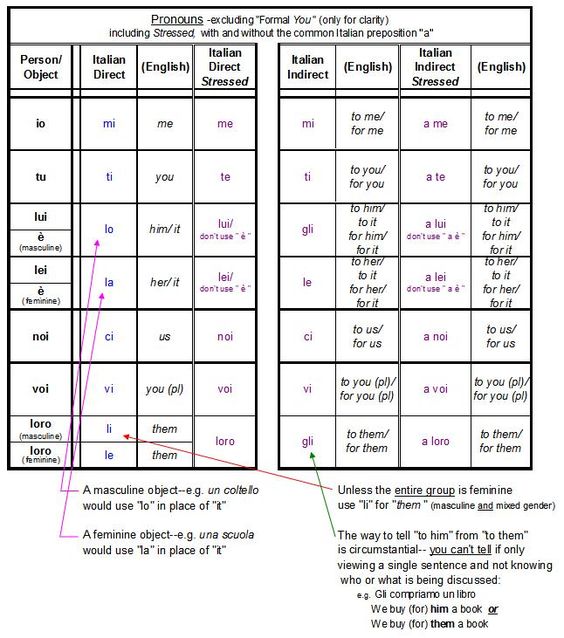
First of all, let's hear from Marta:
So these are used with the transitive verbs, which makes it easier to understand which to use.
The difference between indirect and direct pronouns is usually the presence of a preposition. This can be thought of more easily as a pre-position. These proceed the pronoun in English and are obvious in phrases such as
She sent the letter to you.
I will get the package for you.
The pronoun you is indirect in these cases.
A direct pronoun has no pre-position and so takes form such as:
No Susan, she wants you to go with her.
Are you finished?
These are direct pronouns and have no preposition/por-position. Their position is absolute and no pretext is required.
So the only difference between direct and indirect in an Italian sentence, is also a preposition. The two most common prepositions in Italian are “a” and “di”. But there are others, such as "su", "per", "con", "da", ...etc. A preposition is a "linking" word that "shows the relationship between a noun or pronoun and other words in a sentence." In English, "to", "of", "on", "by", "with", "from", ...as above.
In Murray's diagram, you will notice that for the same object/ subject for both direct and indirect pronouns, some of the terms are shared; specifically “mi”, “ti”, “ci” and “vi”.
So the lazy method is to memorize that the presence of the English words to OR for are a giveaway for “indirect”, keeping in mind that it doesn’t work for verb infinitives— mangiare is the verb “to eat”, but there are no pronouns involved there, so there’s never any “direct” or “indirect” verbs. Only with objects and people. (We’re not even going to start discussing “Piacere” here, so forget that!)
So looking at a few lines of the table, you’ll see that:
-
mi means me (direct), but both mi and a me mean either to me , or for me (indirect).
-
lo means him (direct), but gli means either to him , or for him (indirect) , or even to/ for them (indirect).
and so on.
Thus; if you give something to someone, or make something for someone, then you need to look on that table for the indirect object pronoun. Again, the presence of “to” or “for” is your quick magic reminder for indirect objects but, indeed, any preposition should raise the same flag.
You probably already know this, now, but the “clitic” pronoun form is placed in front of the verb form. The verb form tells you who the person performing the action (a verb) is.
It is easy to practice in English. You would never say “To him I see”, so in Italian you would never say “Gli vedo”, because “Gli” is “To him”. Not just plain “him”; “To him”. Meanwhile, you’d never say “I give a book her”. You’d say “I give a book to her”, so “to her” is le , not la and you’d obviously use “Le dò un libro”. Where it sometimes gets tricky is when the preposition is only implied in English. “I read him a book” or “I ask her a question” needs to be considered in Italian as “I read (to) him a book” and “I ask (of her) a question”.
Here are some basic examples to help (and hopefully not confuse) you:
-
ama He loves or She loves (or even It loves ); Ci ama he/ she/ it loves us.
-
scrivo I write ; Lo scrivo I write it. Note that it wouldn’t be, “I write him” or “her”. Meanwhile...
-
gli scrivo; gli is “to him”, so then I write to him.
-
Le is “to her”, so then le scrivo I write to her. Unfortunately, le is also feminine “them” on the direct pronoun side, so if the subjects being written are all of feminine gender, Le scrivo could also mean “I write them”.
-
What about a double pronoun sentence? “I read it to him”? That’s easy: Lo leggo a lui
-
I see you Ti vedo (there is no “to” or “for”, so use the table for direct object pronoun).
-
I play for him Gli suono (it can’t be direct, Lo suono, because of the word “for”). You can say the very same thing by using the “stressed form”, but after the verb: Suono a lui.
-
Lo suono is “I play it” (it being a direct object, masculine, such as “un flauto”. Use La suono for “I play it”, it being a direct feminine object, such as “una chitarra”).
The Stressed pronouns do not get placed before the verb; they come after it.
Many of them can also be placed into the verb.
- Posso farlo (I can do it), comes by dropping the "e" from Fare (to do) and adding the pronoun "lo". Do that with most any verb infinitive.
Finally, when used in a negative sentence, the pronoun always goes between non and the verb: Non lo vedo = "I don't see him", or "I don't see it".
That should get you well on the way, and at least 3/4 the way through the Clitics lessons. I’ll leave it to others to explain “Ce” and “Ne”.
By the way, you can quickly spot a Reflexive Sentence if the subject and the pronoun being used are on the same line of the table above, or if the word “si” is present before a verb. (And not sì, meaning “yes”...).
-
Mi lavo; I wash myself (same line for io (lavo) and Mi makes this sentence reflexive).
-
Ti vedi; You see yourself (Tu vedi and Ti on the same line).
-
Ci chiediamo; We ask ourselves (Noi chiediamo/ Ci on the same line).
The word “si” goes in place of him/ her/ it and also them, so there is no Gli/ Lo/ La/ Le/ Li to worry about in reflexive:
-
Si lava; He washes himself, or She washes herself, (or even) It washes itself.
-
Si lavano; They wash themselves. It is obviously not “They wash himself”. “They wash him”, on the other hand, is not reflexive, does not use “si”, and is simply “Lo lavano -- as per the rules on direct pronouns, in the initial section of this essay.
ne, ci and se - Learning Grammar Italian
- ne and ci are two extremely useful pronouns which have no single equivalent
in English. There are some phrases where you have to use them in Italian.
Ci substitutes phrases or words introduced by: a, in, con, su or with places.
No, non ci voglio uscire
Ne substitutes phrases or words introduced by: di/della or with amounts/quantities. To have / avere.
sei felice della sorpresa?
1 ne
- ne is a pronoun with several meanings.
- It can refer to amounts and quantities.
- Ne is used with words and phrases that are introduced by DA or DI
- It means some, and can be used without a noun, as in English.
So it is used with: Bisogno, avere, essere, felice, essere sicuro, parlare, sentire parlare, dimenticarsi, non sapere niente.
| Ne vuoi? |
Would you like some? |
| Vuoi del pane? – Ne ho grazie. |
Would you like some bread? –
I’ve got some, thanks. |
- In English, when talking about amounts and quantities, you can say How much do you want of it?, or How much do you want? and How many do you want of them?, or How many do you want? Ne translates of it and of them but it is not optional. So you need to remember to use it in sentences of the kind shown below.
| Ne ho preso la metà. |
I’ve taken half (of it). |
| Ne vuoi la metà? |
Do you want half (of it/of them)? |
| Quanti ne vuole? |
How many (of them) do you want? |
| Ne voglio pochi. |
I don’t want many (of them). |
- Ne also means about it/them, of it/them, with it/them, and so on, when used with Italian adjectives or verbs which are followed by di, for example contento di (meaning happy about), stufo di (meaning fed up with), aver paura di (meaning to be afraid of), scrivere di (meaning to write about).
| Ne è molto contenta. |
She’s very happy about it. |
| Ne sono conscio. |
I’m aware of it. |
| Ne erano stufi. |
They were fed up with it. |
| Ne sei sicura? |
Are you sure (of it)? |
| Ne hai paura? |
Are you afraid of it? |
| Ne ha scritto sul giornale. |
She’s written about it in the paper. |
| Non se ne accorge. |
He doesn’t realize it. |
- With adjectives and verbs followed by di, ne can be used to refer to nouns that have already been mentioned.
| Parliamo del futuro. – |
Let’s talk about the future. |
| Sì, parliamone |
Yes, let’s talk about it. |
| Hai bisogno della chiave? – |
Do you need the key? |
| No, non ne ho più bisogno. |
No, I don’t need it anymore. |
- Ne usually comes before the verb, except when the verb is an order or the infinitive (the –re form of the verb).
- When it comes after the verb the final –e of the infinitive is dropped.
| Volevo parlarne. |
I wanted to talk about it. |
- It follows any other pronoun and is written as one word with it and the verb form.
| Dammene uno per favore. |
Give me one of them please. |
| Dagliene due rossi. |
Give him two red ones. |
- Note that when joined to ne, mi becomes me, ti becomes te, ci becomes ce,
vi become ve and gli and le become glie.
Key points
- ne can be used to mean some.
- ne can also be used to mean of it or of them when talking about amounts and quantities. Unlike English, it is not optional.
- ne is used to mean about it or about them with verbs and adjectives followed by di.
- ne usually comes before the verb.
2 ci
- Ci is used with certain verbs to mean it or about it.
| Ripensandoci mi sono pentito. |
When I thought it over I was sorry. |
| Non ci credo per niente. |
I don’t believe it at all. |
| Ci penserò. |
I’ll think about it. |
| Non ci capisco niente. |
I can’t understand it at all. |
| Non so che farci. |
I don’t know what to do about it. |
| Provare |
Provare a qualcosa |
| Essere |
Essere a qualcuna |
| Abituato |
Abituato a qualcosa |
| Stare attento |
Stare attento a qualcosa |
| Riuscire |
Riuscire a qualcosa |
| Pensare |
pensare a qualcosa |
- Ci is often used with Italian verbs which are followed by a, for example:
- credere a qualcosa to believe something, to believe in something
| Non ci credo. |
I don’t believe it. |
- pensare a qualcosa to think about something
| Non voglio nemmeno pensarci. |
I don’t even want to think about it. |
- far caso a qualcosa to notice something
| Non ci ho fatto caso. |
I didn’t notice. |
- Note that the equivalent English verb may not be followed by any preposition at all.
- With verbs followed by a, ci can be used to refer to nouns that have already
been mentioned.
| I fantasmi, non ci credi? |
Ghosts – don’t you believe in them? |
| Non pensi mai al futuro? – |
Don’t you ever think about the |
| Ci penserò quando sarò più vecchio. |
future? – I’ll think about it when I’m older. |
- ci is used with the verb entrare in some common idiomatic phrases.
| Cosa c’entra? |
What’s that got to do with it? |
| Io non c’entro. |
It’s nothing to do with me. |
- Like ne, ci usually comes before the verb, except when the verb is an order,
the infinitive (the –re form of the verb) or the –ing form.
Key points
- ci is used to mean it or about it.
- ci is used with verbs which can be followed by the preposition a.
- ci usually comes before the verb.
"Ce" is the form that the "ci" particle assumes when put in front of "lo", "la", "li", "le", or "ne"
3 se
- This is slightly different as it either means if or self.
La bambina parla con se stessa
The girl speaks to herself.
Se means self in the above
Lei non sa se viene o va
She does not know if she is coming or not
Se means If in the above.
Conversely, Si can mean we rather than yes in the same way.
Have a test: